
Reviews

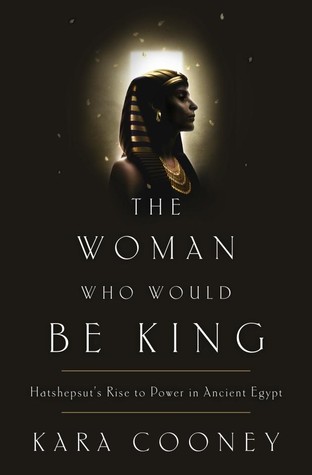
The Woman Who Would Be King: Hatshepsut as a Feminist Icon

The Woman Who Would Be KingHatshepsut has been in my periphery as something amazing, something more for as long as I can remember. I remember little blurbs about her in books I saw as a child on Egyptian history. I saw her statue at the British Museum when I was only 18 years of age, and marvelled at the thought of a woman so powerful.

So when I saw given the opportunity to read this book, I leapt at it with both hands.

It should be noted though, that I am not an Egyptologist and when it comes to mythology I tend to lean toward the Greeks and Romans, for no reason in particular.

But the idea of a female Pharaoh? It appeals. Especially in a world where women are often still treated as second class citizens.

I of course, went into it with little understanding of Egyptian life, and therefore this book was definitely a breath of fresh air.

Kara Cooney cares about Hatshepsut, and the history of Egypt, something which is clear in the writing about this Queen. Half-historical and half-speculative fiction this book weaves a wonderful tale and characterization of the female Pharaoh from the beginning of her life, when she was a mere child, raised in Egyptian nurseries to taking up the mantle.

There are passages such as the one below, which enrich the display of power earned by one woman, with help from her own mother that drew me in.

Hatshepsut has the misfortune to be antiquity’s female leader who did everything right, a woman who would match her wit and energy to a task so seamlessly that she made no waves of discontent that have been recorded. For Hatshepsut, all that endured were remnants of her success, props for later kings who never had to give her the credit she deserved.

This passage, a reminder of what would have been left after her, perhaps those who were ungrateful of having “endured” a female ruler, but along with many others speak of how powerless women really were then. And perhaps those feelings are echoed, in some way how powerless women are today.

It is this book that showed me, in some small way, how far the world has come, but how much we have to learn from each other, from women from other regions, from other times.

30 Day Challenges

Book Challenge Day 6

6. A book that makes you sad.

There are quite a few books that make me sad, it’s so very hard to pick just one. And to do it without spoilers.

So here are two.

the book thiefThe Book Thief by Markus Zusak

This book, about the childhood view of war, about Death’s view of senseless violence triggered something inside of me that touched me deeply. And the losses in the book, which I read in October, around my father’s birthday only seemed to invigorate the loss that I was still feeling over him from July 21. Each death in the novel, whether it was a minor character or not touched my heart and angered me. Yet it was one of the best books I read last year.


nightNight by Elie Wiesel

I know so many people who read this book when they were in elementary school/middle school/high school, but I didn’t come upon this book or Elie Wiesel’s story until I took a Holocaust Literature class. This was a class that actually changed my life. I can honestly tell you that. I had the right Professor for it, one who fought to honour those who had been lost in the most respectful manner he could and in doing so allowed his students to see how little we thought of something beyond ourselves.

Elie Wiesel’s heartbreaking, and true, story helped me see that as well. It is a hard read, but I feel a necessary one.

30 Day Challenges

Book Challenge Day 1

1. The best book you read last year.

I actually picked three, because I read from very different genres.

Non-Fiction

We Wish to Inform You That Tomorrow We Will be Killed Along With Our Families by Philip Gourevitch

I don’t know what I expected this book to be, or my own reactions to it. But this book was nothing but informative, and my reactions were severe. I was quite young when the situation in Rwanda arose, so my memory of it and my learning after the fact is limited. It was a friend who recommended I pick up this book, as I do enjoy non-fiction but haven’t read any in a while.

This is written in such a way, by Philip Gourevitch that you can’t help but be involved in the lives of those whose stories are presented. You also can’t help but consider yourself, and your own emotional reactions to things and what type of person you are.

It is informative, it is visceral and violent, but it is truthful. It’s a truth that we all need to hear though, that sometimes, we need to look outside of ourselves at the people around us and see what might be needed outside of our own cushy existences.

Fiction

The Book Thief  by Markus Zusak

Spoilers (slightly) for The Book Thief and FreakAngel below.

Continue reading “Book Challenge Day 1”

Book List 2014 · Reviews

Band-Aid for a Broken Leg by Damien Brown

Band-Aid for a Broken LegBand-Aid for a Broken Leg by Damien Brown
My rating: 4 of 5 stars

This book is one of those books that you will either put aside because you can’t handle the subject matter or you will delve deeper into it because you desperately need to know more about what is happening.

Damien’s journey is one filled with heartache, happiness, life and death. All of them clash together and intermingled until I wasn’t entirely sure which was which, or if this kind of life, as a volunteer was just that. Nonetheless, the writing was vivid and captivating, and the story was one I will not soon forget. I don’t know how I ever could.

It is simply put, amazing.

View all my reviews

Book List 2013 · Reviews

We Wish to Inform You That Tomorrow We Will Be Killed With Our Families

We Wish to Inform You That Tomorrow We Will Be Killed With Our Families: Stories from RwandaWe Wish to Inform You That Tomorrow We Will Be Killed With Our Families: Stories from Rwanda by Philip Gourevitch
My rating: 5 of 5 stars

I don’t know what I expected this book to be, or my own reactions to it. But this book was nothing but informative, and my reactions were severe. I was quite young when the situation in Rwanda arose, so my memory of it and my learning after the fact is limited. It was a friend who recommended I pick up this book, as I do enjoy non-fiction but haven’t read any in a while.

This is written in such a way, by Philip Gourevitch that you can’t help but be involved in the lives of those whose stories are presented. You also can’t help but consider yourself, and your own emotional reactions to things and what type of person you are.

It is informative, it is visceral and violent, but it is truthful. It’s a truth that we all need to hear though, that sometimes, we need to look outside of ourselves at the people around us and see what might be needed outside of our own cushy existences.

View all my reviews